Showing posts with label 2000ad. Show all posts

24 August, 2018

Just Some Thoughts About Artistic Processes


I've been experimenting with different mark-making techniques recently. Whilst I've always found success with using fine liners and markers to ink my work, I've often found them a little restricting when it comes to a nice line flow. The problem, as I see it, is that it's only the very tip of the fineliner that can be used to make a mark, whereas a traditional pencil can give you varying degrees of line weight, smoothness and density in many different ways.

This lack of fluidity can mean that the inking process extinguishes some of the energy held within the pencils. This is mainly due to the fact that I have to hold the pen a certain way - less like a brush and more like a - well - pen. Of course, control and patience is important when inking. Not everything can be a sketch. Figures, poses, landscapes, expressions, whatever the subjects are - need refining, in the same way a sculptor can take a raw mass of material, and carve something into it. Body language and form can usually do a lot more for expression of movement than the use of line - I prefer to show the trajectory of movement within a panel through spacial relations between things, over speed lines or 'blurring' movement. But it's easy to lose momentum when you have to keep concentrating on how you're holding the pen in case you might  fuck up the line, straight or curved.

I think the reason I've always been so fond of fine-liners is because it's a cheap(ish), dry, easy-to-use tool, that I've seen other artists use for inking more than other tools. I know that ink dipping pans and brushes are more famously used for inking, but the messiness and expenses involved can be a little intimidating. Especially if the room you're renting stupidly has mint green walls that are very good at showing up large splashes of ink.
Well, I'm out of that room and I've cracked out the old caligraphy pen and Indian ink, and attempted to get good at that. I still find the same problems with it as I've always had, namely, blotting ink all over completed sections of the drawing and ruining my fucking day. How do other artists avoid this?!
Another thing is the fact that you have to keep dipping the pen to get more ink. I'm getting used to it, but it did mean ruining lines, because the ink ran out, and getting more ink meant throwing off the amount being used, resulting in thicker lines that should be thinner to be more uniform. That said, it's pretty great to be able to change up the line thickness via pressure. I've always liked using line weight to give a sense of gravity to an image as well as lighting, texture or depth. It's also fun trying to make it all come together in a way that's visually consistent.


Aside from inks - by using graphite sticks instead of conventional or mechanical pencils, I've been able to use the whole of the sharpened end of the pencil, as opposed to the lead point of a normal pencil. I've then been able to work into it with a mechanical pencil to bring out the deets. This looks good on smooth paper and I'm sure it looks great on textured paper too. However - graphite doesn't erase very easily, so it's not as great when trying to ink over the top of it, unless the graphite intends to be left there.


Experimenting with new materials is so important for comic artists. It's a super fluid process, this art malarkey, and your ideas of what art is to you should be changing as much as you do as a person. In comics, I think this is especially true. It can be easy for attitudes towards art to stagnate when too many people try to emulate Marvel comic styles, though I'll be the last person to say that admiration of a certain style is a bad thing.  I can look at my wall right now and see R. Crumb, Moebius, Frank Miller and Ralph Steadman-style art drawn by my own hand. Everyone starts out that way!

I think it stems from this idea that brand comes first for an artist in this online age, and people confuse that with style as an identity, which creates an echo chamber of style within online communities: copy-of-a-copy stuff. Comics are a very unique storytelling format, but it's vague enough of a concept that all methods of art can be applied to it, from fine art, to graphic design, to photography, to sculpture or performance art. Style is not as important as voice, in fact it's a consequence of voice. There are millions of artists out there with varying degrees of experience and abilities, and the ones that stick out are the ones with a clear indication of voice.
While there's a very clear style that is successful, it can be easy when looking at a wall of comics to think that only one way of drawing is the 'right' way. But just because the Jim Lees  and Rob Liefelds of the world have a similar commercial style, it doesn't mean that they don't have a ton of sketchbooks at home filled with personal visual experimentation. How else could they have created their style in the first place?
It's cool seeing how artists like Picasso or Goya changed their style based on their changing perceptons of their reality. Likewise, It's cool seeing how other comic artists have changed their style over the years to reflect their perspective of what comics are to them. Jack Kirby and Mick McMahon are two comic artists I think of that were like this.


Goya
Picasso


Jack Kirby

Mick McMahon


Even if artists return time after time to a certain technique that they're drawn to (pun not intentional), by exploring different materials, you get to visually represent things differently and develop your ability to draw and communicate too. Investing in a WACOM tablet is good, but so is investing in paper and charcoal.

25 May, 2016

Catching Up On Some Classic Sci Fi


Beer, Metallica's Kill 'Em All and 2000AD. That's a good Wednesday midnight if I ever heard one.

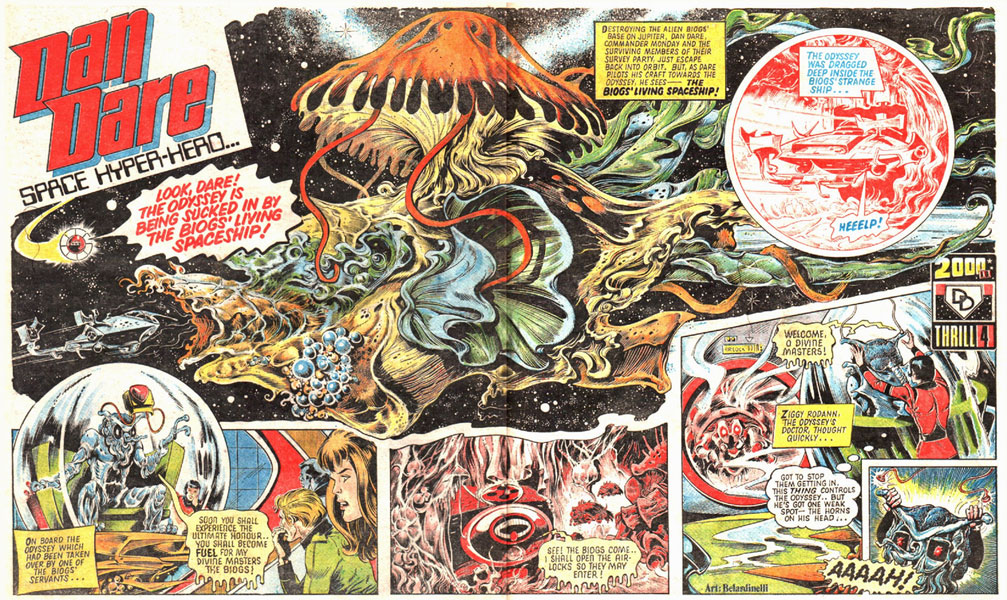
I've recently been reading Dan Dare: The 2000AD Years Vol. 1. I'm not really that familiar with DD - I know of his publication origins in Eagle, but I've never read any.  and while I've only finished the first storyline so far, I now have a new favourite artist - Massimo Belardinelli.


The future as we envision it today - cynicism and fears about the fate of humanity aside -  is very consistent. All technology is synergised, working together on user-friendly platforms. When I imagine the representations of this future on film, names like Minority Report, Star Trek 2009 and Ex_Machina come to mind. Everything is digital and sleek, made of variations of gorilla glass, white light and chrome. Their aesthetics are deceptively simple and pleasing to the eye, though somewhat sterile and lacking in character. I guess the closer we get to the future that all the great minds foretold through art and science, the more accurate that fictional portrayals of it get. 


But Belardinelli's work is so out there and intense! It encapsulates everything I love about vintage sci-fi. It's like a Wally Wood sci-fi strip took acid. It's not a completely analogue world like a Wally Wood sci-fi, the tech feels more post-2001 (probably because it is.) But there are space suits made of weird fabric, guns in leather holsters, creative alien designs and a very busy space backdrop. Lots of nebulae and cosmic energy. Each issue is only about 5-6 pages long so it makes sense to burn brightly and quickly. It means every issue structure is simple: 


  1. Splash page with colour, that pulls you straight into the action
  2. Next spread packs as much character and story as it can, and does it surprisingly well
  3. Final page ends on a big dramatic event or image, the events of which will be the splash page on the next issue.  


These spreads just make me want to draw forever. There's so much packed into each panel and page, and with so much energy and action. Reading this is like listening to a hardcore punk album, where every song is around 1 or 2 raw, intense minutes. That's kind of what all early 2000AD is like though -  I have a small collection that I found around charity shops and second hand bookshops, and they read like pulp fiction. The paper is cheap newspaper paper, and they feel like zines or something, as if they were photocopied at home and sold in record stores.

If you find yourself in the presence of 2000AD's run of Dan Dare, check it out!


(as a bonus, here's one of my favourite Sci Fi images ever by Frank Frazetta)


08 April, 2016

Future Shock! The Story Of 2000AD


Today I watched Future Shocks! The Story Of 2000AD and I may have found one of the best opening titles to a documentary ever. It's an exhilarating animation of the most iconic 2000AD images to some metal soundtrack that I can't find anywhere.
The documentary itself is a very insightful trip into not only the history of 2000AD, but also the British comic industry at the time. It also brought to my attention the kinds of comics that have been big in the UK and how they differ from US comics.
While the US have always ruled the comics world with superheroes, there are strong themes of anarchy and anti-establishment-type characters running through the history of British comics. The Beano has Dennis The Menace (the good one), Roger The Dodger, The Bash Street Kids - generally children who got back ad parents, teachers, the police and responsibility. The issues from the 90's that I owned as a smaller, smellier human are wonderfully chaotic in art and story, containing an energy that I have aspired to create in my work.
I also visited the Comics Unmasked: Art And Anarchy In The UK exhibition in the British Library in 2014, which showcased a fantastic array of comic history this side of the Atlantic. There was everything from Ally Sloper, who is perhaps the first comic book character of all time. Ally Sloper is an anti-hero type of character, trying to scam people and dodge his landlord. He's a loveable rogue. There was also original art from the banned Dredd storyline featuring a war between McDonald's and Burger King, and David Lloyd's amazing original art for V For Vendetta. That really gave an insight into traditional ways of working as opposed to digital means. Also very inspirational to me, as I love to work traditionally first, digitally second.

I had also never really considered how influential it was for in Hollywood. Obviously, in films like Robocop and 28 Days Later, you can see much more of an almost pulpy, violent tone and style seen in Progs. It's a huge inspiration to things like that, but Grant Morrison makes a good point that Michael Bay's Transformers are really closer to the likes of ABC Warriors than they are to the nostalgic 80's toys commercial.
It's not hard to imagine all this, though. Taking inspiration from  France's Heavy Metal, American films and a British society heading down the shitter, British comic writers and artists working for 2000AD were crafting sci fi stories and characters with a harder edge than had ever been seen before outside of EC Comics. They were violent, punchy and full of subtext, and a huge contrast to the fun and dumb Superhero comics of America. Once those creators crossed the Atlantic to Marvel and DC, suddenly Wonder Woman was having a breakdown, Batgirl was paralysed and Superman was dying. American comics were a whole other blanket fort for them to play in, and they took great pride in dismantling the neighbour's toys.

So yeah, the doc. First of all it was so great seeing so many inspirations talking about comics and their careers! Dave Gibbons, Brian Bolland, Grant Morrison, Kevin O'Neill...so many people whose work I revisit again and again. There was a noticeable lack of Alan Moore - but anyone who knows anything about Alan Moore should not expect him to make any public appearances, which is totally understandable. I would have liked more inside stuff about the studios and things like that but really interviews were enough. Everyone was engaging, all the appropriate topics were covered, including the early years, controversy and censorship, the way in which comic creators got fucked over a lot, DREDD, and...the other Dredd film.

I highly recommend - it's currently on 4OD I think, I saw it on Sky+. It's also on DVD.