Showing posts with label british comics. Show all posts

23 January, 2018

Fuck That's Right, I Have a Blog!


Turns out I'm as bad with maintaining a blog as I am sticking with my gym membership. Or remembering to take breaks while working, to eat. Turns out the only 'traffic' on this blog at the moment are from a couple of spam websites with massive, raw photos of genitalia , as I discovered while clicking the link in a family-friendly cafe one afternoon.

Lots of things have happened since I last posted! I won't get into the moving to Mallorca to become a teaching assistant. Or the illegal eviction and month of houselessness. Or the Translatlantic/European travel. Or the week working in a prison camp for privileged teens, who just brought me one step closer to sticking my nuts in a microwave and ensuring myself a cringe-free future.

Nah you're not interested in that shit.


What I can tell you about however, is what else art-related I've been up to - namely, getting a comic book gig and getting a digital and physical debut in an 80-page graphic novel!

(Before that, I just want to mention that I also got one of my strips featured in Dirty Rotten Comics #11 this September (available HERE.) I'm grateful to have been featured alongside such great UK talent, and also that my submission features a masturbation joke. Check it out.)

So the BIG thing - Murder Most Mundane. For the past year and a half, I've been working with Mad Robot Comics to create a murder-mystery comic set in the tranquil British countryside. With writers Matt Hardy and Ash Deadman, I've been creating page after page of violence, horror and character pieces.
In Summer 2017, we launched a VERY successful Kickstarter, and from then I've produced the cover, and helped shape the narrative, on a scale that I've never worked on before. Hopefully I will continue to work on more (shorter) projects in the future.

As an artist, I definitely learnt a lot while work on this. Firstly, I learnt the importance of research and planning before starting a final piece. Not that I ever jumped straight into a final piece without any preliminary sketches or tests, but when you're working on 7+ panels a page, on 80 pages, you need to make sure everything works out before starting something you maybe need to correct later.
Sketch after sketch, getting the right poses, the right expressions, the right references via photos, as well as going outside and observing things WITHOUT a camera lens. ACTUAL sketching of real life - perspective, scale, compositions, lighting. I did a lot more studying like this as the project went on. I've never drawn that many establishing shots, or anything that architectural for that matter. So learning how to plan an environment and draw from real life really helped my build a solid foundation that was believable in this fictional world.
After a couple days of coffee and low energy levels per page, you finally get the right layout that everyone's happy with. Then what?

Then you start the page.

Once I was done prelimming, wow. I've never stared so long at white paper, terrified with making that first mark. I know I'm not the only artist who's ever faced this fear. How the fuck do you recreate the perfect sketch again? The short answer is: you can't. Not really. A lot of that has to do with the pressure you give yourself to catch lightning in a bottle twice, but unless you're extremely skilled and talented as technical drawing, it's not going to happen - at least to me. So after a while, I started to create sketches that, while clear, really just captured the essence of what I was going to draw, through gestures and a less detailed version. Even later in the project, I switched my sketches from A5 sketchbooks to A3 sketchbooks, and from there I was able to create better imagery with a better idea of size. Besides, I was working on A3 paper, so it made sense. So once it came round to the final pencils, I was less stressed.


On the actual practical side, I used a lot of grey pencil on my white Bristol Board paper. The grey was fine except that I kept pressing too hard on the page, and I had real problems erasing it without taking off some of the inks. That was stressful. So I adjusted my approach to pencilling. I switched to blue pencil, which I already knew would be easier to remove via scanning and editing. But after a while, it got a little stale to work with. For starters, it was a mechanical pencil, as was the grey pencil. Turns out, while the line is super nice on the smooth paper, it's still easy to press too hard and it feels like there's less room to let go. When it came to the finals, I think that I was thinking too much about 'comic book art', even though my inspirations came, mostly, from other forms of art. I'm a huge fan of the art of Egon Schiele, the Glasgow Boys, R.Crumb, Moebius (the last two who are obviously from comics) and Ralph Steadman to name a few, but the one thing that happens when you focus too hard on your inspirations, is that you forget to be playful with the art. So, I switched back to grey pencil, but this time to a standard wooden pencil. I held it like a paint brush, and suddenly, I had a lot more life in my lines, and I was less afraid to deviate from certain aspects in the sketches on the finals.


Next: inking. Ah, inking. The most disheartening step of all. In the beginning, anyway. At least with pencil, you can attempt to erase lines. I have experience with line weight, and how to balance black and white, feathering etc. I use fineliners and markers all the time.
With fineliners and markers, you tend to feel that you're fucked if you make a mistake. As it happens, if you get adventurous (as you should, this is ART), white acrylic and tip-ex (or Whiteout) works great. The trick is to not overdo either the black or the white, and to keep the inking style consistent throughout the book. That's hard to do when you can see and feel your skill improving, but being able to reel it in is part of being professional - something else learnt from past commission over the last four years.

Next comes the digitising of the page. Been there, done that. 3 scans on an A4 scanner, stitch it together. Adjust levels and curves to match what you were going for on the original page in terms of mark making and line weight. Size it - to what, exactly?
Another problem I encountered that I didn't think about before, was the page dimensions. I even forgot about the bleed! Luckily, this only effected the first couple of pages, which were not in the US comic page dimensions, and were also easily fixed. For the rest, It was nothing but an extra couple of minutes pencilling out dimensions before starting the final page.


It's almost ready and I can't wait to see how it looks. With additional vibrant colours by Ed Bentley, there's going to be two editions released, one with colours and one without colours.
This is going to be...killer! ;)  ;)  ;)  ;)  ;)  ;)  ;)  ;)  ;)  ;)  ;)  ;)  ;)


25 May, 2016

Catching Up On Some Classic Sci Fi


Beer, Metallica's Kill 'Em All and 2000AD. That's a good Wednesday midnight if I ever heard one.

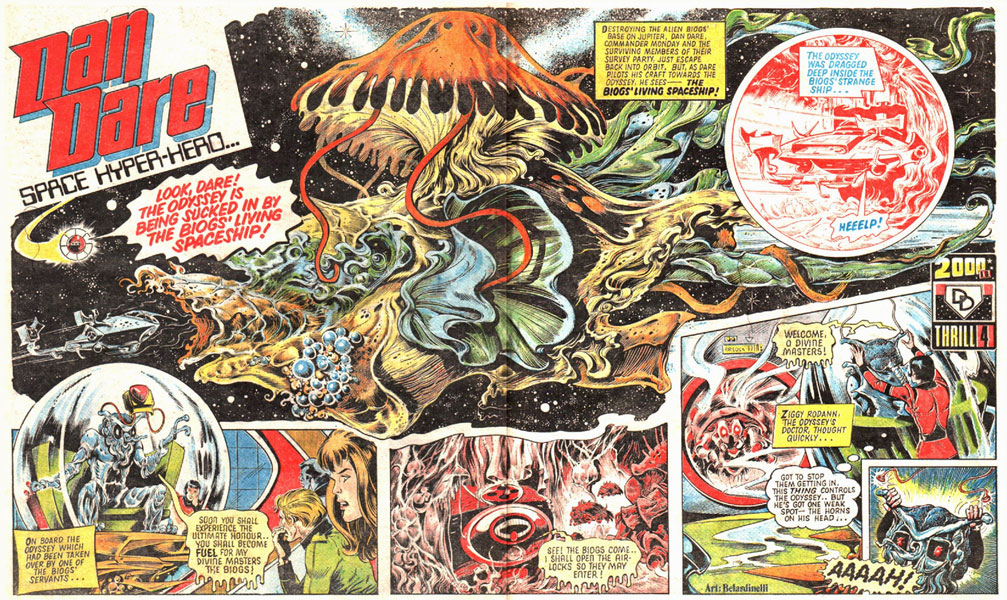
I've recently been reading Dan Dare: The 2000AD Years Vol. 1. I'm not really that familiar with DD - I know of his publication origins in Eagle, but I've never read any.  and while I've only finished the first storyline so far, I now have a new favourite artist - Massimo Belardinelli.


The future as we envision it today - cynicism and fears about the fate of humanity aside -  is very consistent. All technology is synergised, working together on user-friendly platforms. When I imagine the representations of this future on film, names like Minority Report, Star Trek 2009 and Ex_Machina come to mind. Everything is digital and sleek, made of variations of gorilla glass, white light and chrome. Their aesthetics are deceptively simple and pleasing to the eye, though somewhat sterile and lacking in character. I guess the closer we get to the future that all the great minds foretold through art and science, the more accurate that fictional portrayals of it get. 


But Belardinelli's work is so out there and intense! It encapsulates everything I love about vintage sci-fi. It's like a Wally Wood sci-fi strip took acid. It's not a completely analogue world like a Wally Wood sci-fi, the tech feels more post-2001 (probably because it is.) But there are space suits made of weird fabric, guns in leather holsters, creative alien designs and a very busy space backdrop. Lots of nebulae and cosmic energy. Each issue is only about 5-6 pages long so it makes sense to burn brightly and quickly. It means every issue structure is simple: 


  1. Splash page with colour, that pulls you straight into the action
  2. Next spread packs as much character and story as it can, and does it surprisingly well
  3. Final page ends on a big dramatic event or image, the events of which will be the splash page on the next issue.  


These spreads just make me want to draw forever. There's so much packed into each panel and page, and with so much energy and action. Reading this is like listening to a hardcore punk album, where every song is around 1 or 2 raw, intense minutes. That's kind of what all early 2000AD is like though -  I have a small collection that I found around charity shops and second hand bookshops, and they read like pulp fiction. The paper is cheap newspaper paper, and they feel like zines or something, as if they were photocopied at home and sold in record stores.

If you find yourself in the presence of 2000AD's run of Dan Dare, check it out!


(as a bonus, here's one of my favourite Sci Fi images ever by Frank Frazetta)


08 April, 2016

Future Shock! The Story Of 2000AD


Today I watched Future Shocks! The Story Of 2000AD and I may have found one of the best opening titles to a documentary ever. It's an exhilarating animation of the most iconic 2000AD images to some metal soundtrack that I can't find anywhere.
The documentary itself is a very insightful trip into not only the history of 2000AD, but also the British comic industry at the time. It also brought to my attention the kinds of comics that have been big in the UK and how they differ from US comics.
While the US have always ruled the comics world with superheroes, there are strong themes of anarchy and anti-establishment-type characters running through the history of British comics. The Beano has Dennis The Menace (the good one), Roger The Dodger, The Bash Street Kids - generally children who got back ad parents, teachers, the police and responsibility. The issues from the 90's that I owned as a smaller, smellier human are wonderfully chaotic in art and story, containing an energy that I have aspired to create in my work.
I also visited the Comics Unmasked: Art And Anarchy In The UK exhibition in the British Library in 2014, which showcased a fantastic array of comic history this side of the Atlantic. There was everything from Ally Sloper, who is perhaps the first comic book character of all time. Ally Sloper is an anti-hero type of character, trying to scam people and dodge his landlord. He's a loveable rogue. There was also original art from the banned Dredd storyline featuring a war between McDonald's and Burger King, and David Lloyd's amazing original art for V For Vendetta. That really gave an insight into traditional ways of working as opposed to digital means. Also very inspirational to me, as I love to work traditionally first, digitally second.

I had also never really considered how influential it was for in Hollywood. Obviously, in films like Robocop and 28 Days Later, you can see much more of an almost pulpy, violent tone and style seen in Progs. It's a huge inspiration to things like that, but Grant Morrison makes a good point that Michael Bay's Transformers are really closer to the likes of ABC Warriors than they are to the nostalgic 80's toys commercial.
It's not hard to imagine all this, though. Taking inspiration from  France's Heavy Metal, American films and a British society heading down the shitter, British comic writers and artists working for 2000AD were crafting sci fi stories and characters with a harder edge than had ever been seen before outside of EC Comics. They were violent, punchy and full of subtext, and a huge contrast to the fun and dumb Superhero comics of America. Once those creators crossed the Atlantic to Marvel and DC, suddenly Wonder Woman was having a breakdown, Batgirl was paralysed and Superman was dying. American comics were a whole other blanket fort for them to play in, and they took great pride in dismantling the neighbour's toys.

So yeah, the doc. First of all it was so great seeing so many inspirations talking about comics and their careers! Dave Gibbons, Brian Bolland, Grant Morrison, Kevin O'Neill...so many people whose work I revisit again and again. There was a noticeable lack of Alan Moore - but anyone who knows anything about Alan Moore should not expect him to make any public appearances, which is totally understandable. I would have liked more inside stuff about the studios and things like that but really interviews were enough. Everyone was engaging, all the appropriate topics were covered, including the early years, controversy and censorship, the way in which comic creators got fucked over a lot, DREDD, and...the other Dredd film.

I highly recommend - it's currently on 4OD I think, I saw it on Sky+. It's also on DVD.